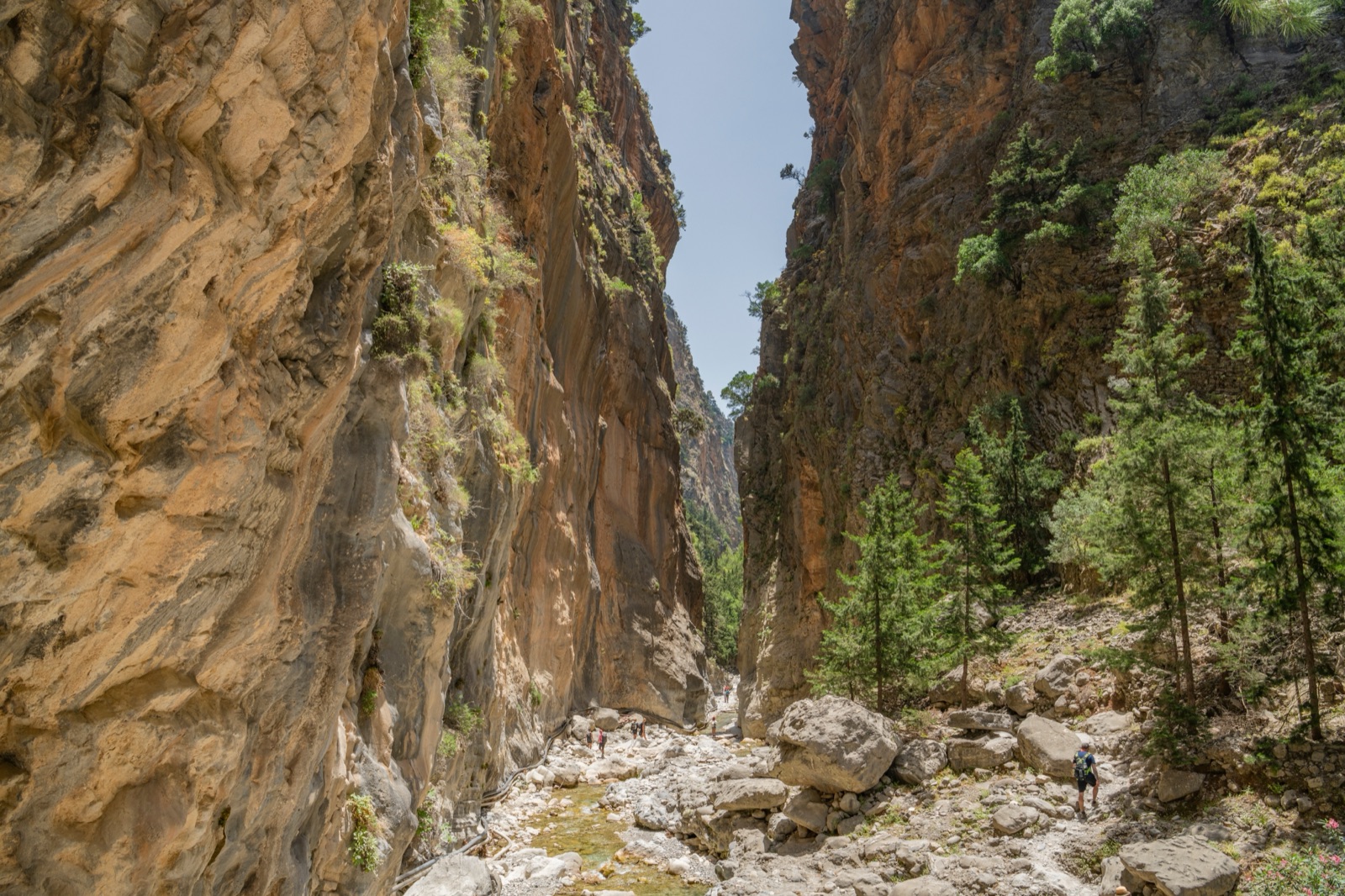
The Samaria Gates, the Easy Way and Agia Roumeli: Crete's South Coast End of the Gorge
Most people experience the Samaria Gorge from the top down, arriving at its southern end exhausted after a long descent. But the south end has a life of its own. Here the gorge reaches its most dramatic point, the Gates, and then opens out to Agia Roumeli, a village by the Libyan Sea that no road has ever reached. For visitors who do not want the full 16 km walk, the south end is also the way in: a boat along the coast and a short walk up the gorge brings you to its most famous sight.
This guide covers the Gates, the easy way into the gorge from the sea, Agia Roumeli and the south-coast boats, and the story of the national park that protects it all.
The Gates
The narrowest point
The Gates are the image of Samaria. At the Gates the sides of the gorge close in to only four metres apart and rise almost 300 m. The narrowest stretch is known as the Gates, or, incorrectly, the ‘Iron Gates’. Standing between the walls, looking up at the strip of sky far above, is the moment every walker remembers. Even after hours of walking, the scale of the place stops people in their tracks, and the sudden coolness of the shade between the walls is welcome on a hot day.
Where they are
The Portes (Gates), the most famous sight in the gorge, are about 1.5 km from the Agia Roumeli outpost. That is what makes the easy way possible: from the southern entrance, the Gates are within a relatively short walk.
Seeing them well
- Go early in the day, before the walkers descending from the top arrive in numbers.
- Take your time: the walls change as you move through, and the light shifts through the day.
- Be considerate: the path is narrow here, so let others through rather than stopping in the tightest spot.
Samaria the easy way
How it works
The easy way reverses the usual logic. Instead of walking down from the mountains, you arrive by sea and walk up into the gorge.
Samaria the easy way. Bus to Chora Sfakion and the ferry to Agia Roumeli, then a walk up from the south end of the gorge towards the Iron Gates. A shorter walk, about 9 hours in all including the travel.
The rules for the south entrance
The same ticket applies: an individual ticket costs €10.00, and an entrance ticket, bought online from NECCA, is mandatory. Entry times matter too:
- Entry for the whole route, or part of it, is allowed from 07:00 to 13:00; from 13:00 visitors may walk only the first 2 km from either entrance, and everyone must leave the park by 18:00.
- From 13:00 to 16:00, visitors entering from the south may walk only the first 2 km, from Agia Roumeli to the Christos rest area.
So for the Gates, arrive at the southern entrance before 13:00.
Who it suits
The easy way is ideal for families, for people who cannot manage a long descent, and for anyone who wants to see the gorge’s highlight without committing to a full day’s hike. There is no age limit, but the long, rocky path is not recommended for small children, which makes this shorter walk the natural family option.
A day the easy way, step by step
- Morning: bus from the north coast to Chora Sfakion; buses run from the north coast to Chora Sfakion.
- Mid-morning: the boat along the coast to Agia Roumeli, about an hour.
- Late morning: walk from the village to the southern entrance — the path inside the gorge is 13 km, plus 3 km from the south entrance to Agia Roumeli — show your ticket, and head up the gorge before 13:00.
- Midday: reach the Gates, about 1.5 km from the southern outpost; rest in the shade and take in the walls.
- Early afternoon: walk back down to Agia Roumeli for lunch and a swim in the sea.
- Late afternoon: the boat back to Chora Sfakion or Sougia, and the connecting bus to Chania.
The whole day, with the easy-way tour, takes about 9 hours, but much of it is spent on the bus and the boat, and the walking is gentle compared with the full descent.
What to bring for the easy way
- Your ticket, bought online; the same €10.00 ticket applies at the southern entrance.
- Water and a snack; there are springs in the gorge but no shops.
- Sun protection: hat, sunglasses and sunscreen.
- Comfortable walking shoes for the rocky path.
- Swimwear and a towel for the sea at Agia Roumeli.
- Cash or a card for the boat, the bus and lunch.
Walking up the whole gorge
Some hikers go further and walk the entire gorge uphill. Walking up from Agia Roumeli is possible, ideally after a night there, but the last kilometres climb a steep path and it is not for the unfit. It is a tough day, reserved for strong walkers.
Agia Roumeli
The village with no road
Agia Roumeli is not connected to the road network; the only ways there are on foot or by boat. Because of its past importance, Agia Roumeli is reached by many footpaths and trails. Today it is where the gorge meets the sea, with places to stay and eat and the quay where the boats come and go.
Staying the night
The park advises staying overnight in Agia Roumeli rather than making a day trip. A night here changes the experience: you can finish the walk at your own pace, swim in the sea, eat by the water and watch the gorge’s mouth fade into the evening. It also protects you from the one real risk of a day trip: especially in autumn, the gorge may be open but wind can stop the boats leaving Agia Roumeli, so you might have to stay the night.
No car needed
You do not need a car in Agia Roumeli, and buses run from the north coast to Chora Sfakion. Everything is on foot, and the boat is the road.
The south-coast boats
The network
ANENDYK runs boats along the south coast linking Chora Sfakion, Loutro, Agia Roumeli, Sougia and Paleochora. The boat service is limited in winter and becomes daily at the beginning of April.
Frequency and times
- Once the gorge opens, boats between Chora Sfakion, Loutro and Agia Roumeli run about 2–3 times a day, and the Paleochora–Sougia–Agia Roumeli route once a day.
- The boat between Agia Roumeli and Chora Sfakion takes about an hour, a little longer to Paleochora.
- ANENDYK boats leave Agia Roumeli at 17:30 for Chora Sfakion or Sougia, where buses wait for the return to Chania.
- Boats may be delayed or cancelled in bad weather.
Connecting buses
Return buses to Chania leave Chora Sfakion at 18:30 and Sougia at 18:15, after the ferry arrives.
The coast from the sea
The boat trip is a highlight in its own right, with views of the wild White Mountains and the coast from the deck.
Combining the easy way with the full descent
Some visitors do both: the easy way on one day, as an introduction, and the full descent from Xyloskalo on another, when they know what to expect. Others walk the full gorge and then spend the next day in Agia Roumeli, walking back up to the Gates in the morning light when the path is quiet. Either way, a stay on the south coast turns the gorge from a single, rushed day into something to savour.
Photography at the Gates
- Morning light reaches the upper walls first, with the slot still in shade below.
- A wide lens helps capture the height of the walls and the narrowness of the gap.
- Include a person for scale; the walls dwarf anyone standing between them.
- Look back as well as forward: the view changes completely once you pass through.
- Be quick and courteous in the narrowest section, where others need to pass.
The south-coast bases
- Chora Sfakion is the main port for the Agia Roumeli boats and the end of the bus line from Chania.
- Loutro, between Chora Sfakion and Agia Roumeli, is a stop on the boat route.
- Sougia has boats to Agia Roumeli and buses back to Chania; a bus also leaves Sougia for Xyloskalo every day at 07:00, useful for walking the gorge from the top.
- Paleochora, further west, is linked to Agia Roumeli by the daily boat via Sougia.
Staying on the south coast for a few days makes it easy to do the easy way one day and the full gorge another. The boats that link these villages are the backbone of travel here: they carry walkers and locals alike, and their timetable shapes the rhythm of every day. Pick up a current timetable when you arrive, keep an eye on the weather, and you will find the south coast one of the most rewarding corners of Crete to explore slowly, with the gorge as its centrepiece.
The national park
A refuge for the kri-kri
The gorge became a national park in 1962, especially as a refuge for the rare kri-kri, the Cretan wild goat. UNESCO has designated the gorge a Biosphere Reserve. The protection covers the whole gorge, its plants and its animals, and it is why the rules on the path are so strict.
The abandoned village
The village of Samaria, inside the gorge, was abandoned by its last inhabitants in 1962; the village and the gorge are named after its ancient church, Ossia Maria. It lies further up the gorge than the Gates, beyond the reach of the easy way.
How the gorge was made
The gorge was carved by a small river between the White Mountains and Mount Volakias. The Gates are the most dramatic result: a place where the river has cut a slot through the rock, leaving walls almost 300 m high.
The old trail
At the top of the gorge, Xyloskalo, ‘wooden stairs’, is named after an old staircase of cypress trunks; the trail, built by Manousos Koundouros in the late 19th century, is 2–2.5 m wide.
Tours from further afield
Samaria from Heraklion, Agia Pelagia or Malia. A long day from the Heraklion area to Omalos and down the 17 km gorge, with the White Mountains drive. About 12 hours.
Full-day trek from Rethymno. The same gorge day with pickup in Rethymno and a guide.
Samaria with a hiking guide. The 16 km gorge from Chania with a hiking guide carrying radios, a safety briefing before you start and the ferry from Agia Roumeli. About 14 hours.
The tours page lists them all with live prices. For the full descent, see walking the Samaria Gorge; for buses and boats, how to get to the Samaria Gorge.
When to go
- The season: the national park opens from 1 May to 31 October, 7 am to 4 pm, with entrances at Xyloskalo and Agia Roumeli.
- Spring: the boats become daily from the beginning of April, and if the weather is good and the path undamaged after winter, the gorge can open earlier, but not before 10 April.
- Summer: the busiest time, with the most boats and the most walkers. The south end can be very hot in the afternoon; go early.
- Autumn: quieter and cooler, but storms can close the gorge and wind can stop the boats. Build in a spare day if you can.
Staying safe at the south end
- Watch the time: entry for the Gates closes at 13:00 from the south, and everyone must be out by 18:00.
- Mind the heat: carry water and rest in the shade of the walls.
- Watch for falling rocks, and follow the signs and the rangers.
- Know the emergency number: the emergency number is 112.
- Check the boats before you commit to a late return; weather can cancel them.
Rules to remember
- Swimming in the park’s rivers and streams is prohibited; the sea at Agia Roumeli is the place to swim.
- Camping in any form and staying the night in the park are prohibited.
- Keep your ticket to be checked at the exit.
- Follow the rangers’ instructions and the signs, especially about falling rocks, and never leave the main path.
Practical tips
- Check the gorge’s status the evening before; the gorge can close for a day or more if rain or a heatwave is expected; the decision is taken the day before.
- Buy your ticket online before you travel.
- Reach the southern entrance before 13:00 if you want to walk to the Gates.
- Carry water and sun protection; the lower gorge can be hot.
- Check boat times at the quay, and allow for weather delays.
- Consider a night in Agia Roumeli for the most relaxed experience.
Accessibility
The easy way is gentler than the full descent, but it is still a walk on a rocky path with uneven ground, and it is not suitable for wheelchairs. The boat along the coast and the village of Agia Roumeli can be enjoyed without entering the gorge; ask the boat company about boarding assistance.
Frequently asked questions
How far are the Gates from Agia Roumeli?
The Gates are about 1.5 km from the Agia Roumeli outpost at the southern entrance of the gorge.
How wide are the Samaria Gates?
The sides close in to only four metres apart and rise almost 300 m.
Can I see the Samaria Gorge without walking the whole thing?
Yes. Take the boat to Agia Roumeli and walk up towards the Gates; the easy-way tour does this in about 9 hours including travel.
How do I get to Agia Roumeli?
Only on foot or by boat. ANENDYK boats link it with Chora Sfakion, Loutro, Sougia and Paleochora.
Why is it called Samaria?
After the ancient church of Ossia Maria in the village of Samaria, inside the gorge.
When are the south-coast boats running?
The service is limited in winter and becomes daily at the beginning of April. Once the gorge opens, boats between Chora Sfakion, Loutro and Agia Roumeli run about 2–3 times a day.